If you've spent any time researching personal weather stations in the $150–$250 range, you've ended up on these two. The Ambient Weather WS-2902C and the Ecowitt WittBoy (also sold as the HP2560 family) are the most commonly purchased mid-range stations and they come up in nearly every forum comparison thread. The problem is that most comparisons either come from vendor blogs or from forum posts that focus exclusively on sensor specs — the part that matters least.
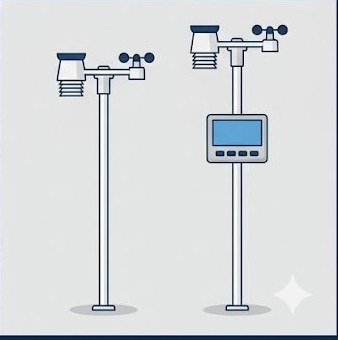
This comparison covers the factors that actually determine which station serves you better over the long run. It assumes you want accurate data, want to share it with public networks, and may want to expand your sensor collection over time.
Quick Verdict
- Buy the Ecowitt WittBoy if: You want the better software ecosystem, plan to add sensors over time, want local data logging, or use Home Assistant or WeeWX.
- Buy the Ambient WS-2902C if: You want a physical display console in your house, prefer a cloud-service-centric setup without local networking complexity, or are buying as a gift for someone who wants simplicity above all.
What's the Same
Both stations ship with essentially the same sensor array: outdoor temperature and humidity, wind speed and direction, rainfall (tipping bucket), UV index, and solar radiation. Both connect to your home Wi-Fi and upload to Weather Underground, Weather Cloud, and other public networks. Both are in the same price range ($170–$210 street price as of mid-2025). Both have passive radiation shields included in the box.
At the sensor hardware level, both use similar OEM components — the temperature, humidity, and rain sensors in both come from the same Taiwanese supply chain. Real-world temperature accuracy is comparable between the two when both are correctly placed. The meaningful differences are entirely in software, ecosystem, and expandability.
Head-to-Head Comparison
| Feature | Ambient WS-2902C | Ecowitt WittBoy |
|---|---|---|
| Price (mid-2025) | ~$189 | ~$179 |
| Physical console/display | ✓ Included (7" color LCD) | ❌ App/web only |
| Configuration app | AmbientWeather.net + app | WSView Plus (local control) |
| Local network access | Limited (cloud-dependent) | Full local API + Ecowitt protocol |
| Sensor expansion | Limited (few add-on sensors) | 30+ compatible add-on sensors |
| WeeWX compatibility | Via WU only | Native Ecowitt driver, full support |
| Home Assistant integration | Via WU only | Native integration, local polling |
| Weather Underground upload | Direct, well-tested | Direct (see setup guide for firmware notes) |
| CWOP upload | Via AWN dashboard | Direct APRS-IS or via WSView Plus |
| Firmware update frequency | Infrequent (~yearly) | Regular (every few months) |
| Data history storage | AWN cloud (requires account) | Local + cloud options |
| Offline operation | Console displays locally | No display, but data logs locally |
| Setup complexity | Simpler (wizard-driven) | Moderate (more options = more steps) |
| Rain gauge type | Tipping bucket, 0.01" res. | Tipping bucket, 0.01" res. |
| Wind speed range | 0–112 mph | 0–112 mph |
| Temperature range | -40° to 140°F | -40° to 140°F |
| Community/forum size | Moderate | Larger, very active |
The Software Ecosystem — Where It Really Diverges
This is the most important section if you're serious about your weather data.
The Ambient Weather Network (AWN) is a cloud-based platform. Your WS-2902C uploads data to Ambient Weather's servers, which host a dashboard, historical graphs, and API access. It works well for casual users who want to check their readings on a phone or laptop. The limitation: if Ambient Weather's servers are down, or if you want to do anything more sophisticated than their dashboard supports, you're stuck.
The Ecowitt ecosystem is built around a local gateway — the GW2000 in the WittBoy — that runs on your local network. Configuration and data access happen through the WSView Plus app, which communicates directly with the gateway over your Wi-Fi. Data is also pushed to Ecowitt's cloud service (ecowitt.net), but the local operation is independent of the cloud. This distinction matters in several real ways:
- Home Assistant integration via the official Ecowitt integration uses local polling — your home automation system queries the gateway directly, not via cloud. This is faster, more reliable, and works during internet outages.
- WeeWX has an excellent Ecowitt driver that accesses the gateway's local push protocol. Running WeeWX on a Raspberry Pi gives you a fully self-hosted weather station with local data archiving, custom reports, and upload to any network you choose.
- Sensor expansion is dramatically better with Ecowitt. The ecosystem supports over 30 additional sensors: indoor temperature/humidity monitors, soil temperature and moisture probes, lightning detectors, leaf wetness sensors, pond sensors, air quality monitors (PM2.5), and CO2 sensors. All communicate to the same GW2000 gateway and appear in the same WSView Plus interface and dashboard.
The WS-2902C's Ambient Weather ecosystem has some add-on sensor support, but the range is much narrower and the integration is less seamless. If you think you might eventually add a soil moisture sensor for your garden, or an indoor air quality monitor, or an extra temperature probe for your greenhouse, Ecowitt's platform is significantly more capable.
Display Console: The Ambient Weather Advantage
The Ambient Weather WS-2902C includes a 7-inch color LCD console. This is a real display that sits on a desk or counter and shows live conditions at a glance — current temperature, humidity, wind, rain, barometric pressure trend, and UV index — without needing to unlock a phone or open an app.
The Ecowitt WittBoy has no physical console. All data is accessed via the WSView Plus app, the ecowitt.net web dashboard, or a third-party integration. For many users this is fine — they check the app or have a tablet dashboard running Home Assistant. For others, especially those who want to glance at weather data without any technology interaction — or for older family members who find apps frustrating — the Ambient console is a genuine differentiator.
It's worth noting that Ecowitt sells a separate indoor display console (the GW2000 gateway has a companion display available) for around $40–$60. So you can get a display if you want one — it's just not included in the base WittBoy kit price.
Rain Gauge: Performance Is Equal, Maintenance Differs
Both stations use very similar tipping bucket rain gauges with 0.01-inch resolution. Long-term performance of both is comparable when the gauge is correctly placed and regularly cleaned. The funnel mesh screens on both occasionally clog with debris and pollen — this is a maintenance issue with tipping bucket gauges generally, not specific to either brand.
One real-world difference: Ecowitt's rain gauge funnel is slightly wider and the calibration offset is adjustable in WSView Plus without needing to contact support. Ambient Weather's calibration requires going through their customer support to adjust the coefficient, which is a significant inconvenience for stations near a known calibration reference.
Firmware and Long-Term Support
Ecowitt has consistently released firmware updates for its GW-series gateways — typically every 1–3 months with bug fixes, new sensor support, and protocol improvements. The WittBoy running current firmware in 2025 is noticeably more capable than one running 2022 firmware, not because the hardware changed, but because the software improved.
Ambient Weather releases firmware updates less frequently, and several long-standing community requests (better local API access, improved CWOP support) remain unaddressed as of mid-2025. The WS-2902C is a mature product being gradually deprecated in favor of newer models in Ambient's lineup.
Who Should Buy Each
Want to share data to CWOP and multiple networks | Use or plan to use Home Assistant | Want to add soil, lightning, air quality, or indoor sensors later | Want local control without cloud dependency | Use WeeWX or Raspberry Pi | Want active software development and regular firmware updates
Want a physical display console without extra purchases | Value simplicity over flexibility | Are buying as a gift for someone who dislikes app configuration | Only need WU and basic cloud access | Don't anticipate ever adding sensors
The Bottom Line
For the serious hobbyist who reads guides like this one, the Ecowitt WittBoy is the better platform in 2025. Its software ecosystem is more capable, its community is larger and more active, its firmware development is ongoing, and its sensor expansion options are unmatched in this price range.
The Ambient WS-2902C is not a bad station — it's just less flexible. Its console display is a genuine advantage for some households, and its cloud-based simplicity is actually a feature rather than a limitation for users who don't want to think about gateways, local APIs, or firmware updates.
If you're still deciding, our complete buyer's guide covers additional options including the WeatherFlow Tempest (no moving parts, premium price) and the Davis Vantage Vue (best-in-class accuracy at higher cost).
The Ambient Weather WS-2902 WiFi Smart Weather Station is Amazon's Choice in this category — over 12,000 verified reviews, 2,000+ purchases per month, and currently at its lowest price in 30 days. It includes a full 5-in-1 outdoor sensor array, indoor color console display, Wi-Fi connectivity, and uploads to Weather Underground, Weather Cloud, and the Ambient Weather Network out of the box. A complete kit at a competitive price.
View on Amazon →As an Amazon Associate, StationSense earns from qualifying purchases at no additional cost to you.
Frequently Asked Questions
Essentially, yes. The WittBoy is Ecowitt's all-in-one branding for their complete-kit stations using the GW2000 gateway. The HP2560 is the same hardware sold under a different model number in some markets and through some retailers. The GW2000 gateway firmware, WSView Plus configuration, and sensor specifications are identical. If you find an HP2560 at a lower price, you're buying the same station.
Yes, but with limitations. The primary integration method is through the Ambient Weather Network API — your WS-2902C uploads to AWN's cloud, and Home Assistant polls the AWN API using your API key. This works, but it means your Home Assistant weather data is delayed by the cloud round-trip, requires an active internet connection, and is dependent on Ambient Weather's API remaining operational. There is no direct local polling option for the WS-2902C as there is for Ecowitt. For most users this is fine; for users who want local automation that works during internet outages, Ecowitt's local API is a meaningful advantage.
Both use similar tipping bucket mechanisms and neither has a meaningful accuracy advantage out of the box. Real-world rain gauge accuracy is determined almost entirely by placement (the 4:1 rule — see our rain gauge placement guide) and maintenance (keeping the funnel and tipping mechanism clean and debris-free). A well-placed, well-maintained WS-2902C will outperform a poorly placed WittBoy and vice versa. The Ecowitt does allow calibration offset adjustment without involving customer support, which makes it easier to correct a known systematic error.
The HP2550 uses the older GW1100 gateway rather than the GW2000 (WittBoy/HP2560). The GW1100 has less local processing power, a smaller sensor ecosystem, and older firmware. For the current street price difference (usually $20–$30 less), the GW2000-based WittBoy is the better purchase — the expanded sensor compatibility and better software make the price difference worth paying.